
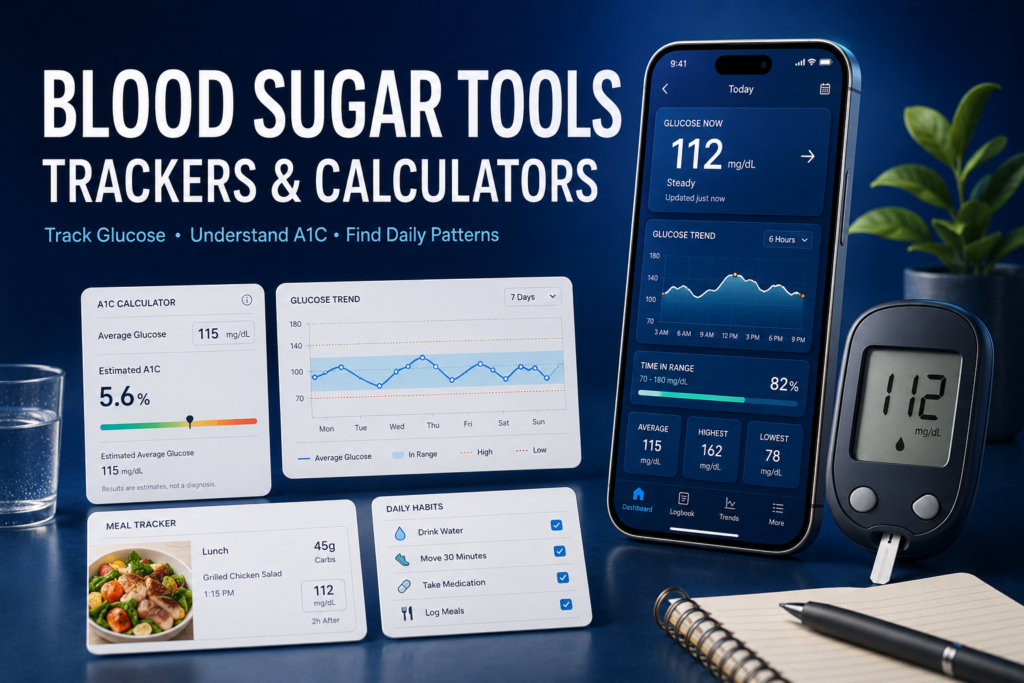
Free Interactive Blood Sugar Resources
Blood Sugar Tools, Trackers & Calculators
Explore practical tools designed to help you record glucose readings, understand everyday patterns, track meals and symptoms, and prepare for more informed conversations with your healthcare professional.
Practical Support for Everyday Tracking
How These Blood Sugar Tools Can Help
Whether you are recording glucose readings, exploring how meals affect your numbers, or getting ready for your next appointment, these interactive resources can help you keep important details organised and easier to review.
Record Your Readings
Keep track of glucose measurements, testing times, meal timing, activity and other useful details in one convenient place.
Explore the glucose trackerUnderstand Meal Patterns
Compare readings taken around meals and record what you ate to identify patterns worth discussing with your healthcare team.
View the meal trackerMonitor Symptoms
Document symptoms such as fatigue, shakiness, dizziness, thirst or brain fog alongside glucose readings and daily activities.
Open the symptoms journalPrepare for Appointments
Organise recent readings, symptoms, medications and questions before speaking with your doctor or another healthcare professional.
See the appointment plannerStart With Our Featured Tracker
Keep Your Blood Sugar Readings Organised
Our Blood Sugar Tracker makes it easier to record glucose readings alongside the everyday details that provide useful context, including meals, symptoms, physical activity and personal observations.
- Log readings with the date, time and measurement unit.
- Record whether measurements were taken before or after meals.
- Include symptoms, exercise, stress and additional notes.
- Review previous entries and export your records for reference.
Understand Your Numbers
Blood Sugar Calculators and Conversion Tools
Use these practical calculators to convert blood sugar units and understand how an A1C result relates to an estimated average glucose reading.
A1C to Estimated Average Glucose Calculator
Translate an A1C percentage into an estimated average glucose value, helping you understand how these two commonly discussed measurements relate.
- Enter an A1C percentage to calculate estimated average glucose.
- View estimated results in both mg/dL and mmol/L.
- Learn why an estimated average may differ from individual meter readings.
Blood Sugar Unit Converter
Quickly convert glucose readings between mg/dL and mmol/L, two measurement units commonly used in different countries and healthcare settings.
- Convert a reading from mg/dL to mmol/L.
- Convert a reading from mmol/L to mg/dL.
- Compare measurements from different devices, laboratories or regions.
Readings, Meals and Everyday Patterns
Glucose and Meal-Tracking Tools
Organise your glucose readings, document meals and review recurring patterns using practical tracking tools designed to support more informed conversations with your healthcare professional.
Blood Sugar Tracker
Maintain a convenient record of your glucose readings and the daily details that can help provide useful context when reviewing your results.
- Record measurement dates, times and glucose units.
- Add meal timing, symptoms and personal observations.
- Review saved entries and download your records.
Meal and Blood Sugar Response Tracker
Record what you eat alongside glucose readings taken around meals to build a clearer picture of your individual daily patterns.
- Log foods, meal times and approximate portions.
- Compare readings recorded before and after eating.
- Include activity, symptoms and additional notes.
7-Day Blood Sugar Pattern Finder
Review a week of recorded readings and daily notes to identify recurring timings or circumstances that may be useful to discuss at your next appointment.
- Organise readings by day, time and meal timing.
- Review notes about sleep, activity and stress.
- Highlight observations for discussion with your healthcare team.
Symptoms, Meals and Everyday Routines
Blood Sugar Symptoms and Daily Habits
Keep useful notes about symptoms, food choices and daily habits that may provide additional context when reviewing your blood sugar records with a healthcare professional.
Blood Sugar Symptoms Journal
Record how you feel alongside glucose measurements, meals and daily activities to create a more detailed personal symptom history.
- Note symptoms such as shakiness, fatigue, dizziness or brain fog.
- Record symptom timing, duration and severity.
- Include relevant glucose readings and personal notes.
Daily Blood Sugar Habits Checklist
Keep track of everyday routines such as hydration, movement, sleep, meal planning and monitoring, based on your individual healthcare plan.
- Check off daily habits and personal routine goals.
- Track hydration, sleep, meals and physical activity.
- Record monitoring or medication tasks recommended by your healthcare professional.
Carbohydrate and Meal Planner
Organise meals and snacks while recording approximate carbohydrate amounts and other notes relevant to your personal eating plan.
- Plan breakfast, lunch, dinner and optional snacks.
- Record approximate carbohydrate amounts for individual meals.
- Review your plan alongside personalised guidance from a qualified professional.
Organise Important Healthcare Information
Medication and Appointment Planning Tools
Keep relevant treatment details, personal observations and appointment questions organised so you can have clearer, more productive conversations with your healthcare team.
Medication and Supplement Log
Maintain an organised personal record of prescribed medications, insulin, supplements and other relevant treatment information.
- Record medication or supplement names and scheduled administration times.
- Note prescribed doses, missed doses and questions for your healthcare professional.
- Document possible side effects or changes you would like to discuss at an appointment.
- Keep a clear reference list when reviewing your current treatment routine.
Healthcare Appointment Preparation Tool
Bring important information together before a medical appointment, including recent readings, symptoms, treatment details and questions you want answered.
- Organise recent glucose readings and recurring observations.
- List current medications, supplements and relevant health concerns.
- Prepare questions about symptoms, testing, meals or follow-up care.
- Create a convenient summary to review or print before your appointment.
Browse the Complete Collection
Explore All Blood Sugar Tools
Find practical calculators, trackers, journals and planning resources designed to help you organise important blood sugar information and everyday observations.
Blood Sugar Tracker
Record glucose readings, measurement times, symptoms and additional daily details. Blood Sugar CalculatorA1C Calculator
Convert an A1C percentage into estimated average glucose in mg/dL and mmol/L. Unit ConversionBlood Sugar Unit Converter
Convert glucose readings between mg/dL and mmol/L quickly and conveniently. Meal TrackingMeal and Blood Sugar Response Tracker
Compare readings around meals and record foods, portions and relevant observations. Meal PlanningCarbohydrate and Meal Planner
Organise meals, snacks and approximate carbohydrate amounts throughout the day. Symptoms JournalBlood Sugar Symptoms Journal
Document symptoms, their timing and severity, and any relevant glucose readings. Medication RecordsMedication and Supplement Log
Keep an organised record of prescribed treatments, supplements and questions. Daily HabitsDaily Blood Sugar Habits Checklist
Track hydration, sleep, meals, activity and other components of your daily routine. Appointment PlanningHealthcare Appointment Preparation Tool
Organise readings, symptoms, medications and questions before your next appointment. Weekly Patterns7-Day Blood Sugar Pattern Finder
Review a week of readings and notes to identify observations worth discussing with your healthcare team.Find Your Best Starting Point
Which Blood Sugar Tool Should You Use?
The most useful tool depends on what you want to record, understand or discuss. Choose the situation that best matches your current needs.
Keep Glucose Measurements Organised
Record the time, measurement, meal timing and notes associated with your individual glucose readings. Use the Blood Sugar Tracker I Want to Understand an A1C ResultEstimate Your Average Glucose
Convert an A1C percentage into an estimated average glucose measurement in mg/dL and mmol/L. Use the A1C Calculator I Need to Convert a ReadingSwitch Between mg/dL and mmol/L
Convert glucose values between commonly used measurement units without changing the underlying result. Use the Blood Sugar Converter I Want to Track Meals and ReadingsReview Your Meal-Related Patterns
Record meals, portions and measurements taken before or after eating to provide additional context for your records. Use the Meal Response Tracker I Want to Document How I FeelRecord Symptoms and Their Timing
Keep notes about dizziness, shakiness, fatigue, thirst, brain fog and other symptoms for discussion with a healthcare professional. Use the Symptoms Journal I Have a Healthcare AppointmentPrepare Your Questions and Records
Gather your readings, medication details, symptoms and questions before meeting with your doctor or healthcare team. Use the Appointment Planner I Want a More Consistent RoutineKeep Track of Everyday Habits
Organise daily routines such as hydration, movement, sleep, meals and monitoring tasks recommended by your healthcare professional. Use the Daily Habits Checklist I Want to Review a Week of ReadingsOrganise Your Weekly Observations
Compare several days of readings and notes to identify recurring observations worth raising with your healthcare team. Use the 7-Day Pattern FinderNot sure where to begin? Start with the Blood Sugar Tracker to organise your readings, then explore additional tools based on the questions or observations that matter most to you.
Start TrackingUnderstand How Your Information Is Stored
Privacy, Browser Storage and Your Records
Our interactive tracking tools are designed to help you organise personal observations conveniently. Understanding where entries are saved and how to protect them can help you use these resources more confidently.
Saved in Your Browser
Tools with a save function store entries locally in the browser used to access the page. Your saved records are generally available when you return using the same browser on the same device.
No Account Required
You can use the tools without creating a user account. Avoid entering unnecessary identifying information, especially when using a shared device or computer.
Download Useful Records
Where available, export entries as a CSV file that can be opened in Excel or print a summary before a healthcare appointment. Store downloaded files securely.
When Could Saved Entries Disappear?
Browser-stored entries may be lost if you clear browsing data, reset your browser, use private browsing, change devices or remove site data. Browser storage is not a guaranteed or permanent backup.
What If You Use a Shared Device?
Anyone with access to the same device and browser profile may be able to view saved entries. Avoid entering sensitive identifying details and remove records when you no longer need them.
Ready to organise your readings and personal observations?
Explore the Blood Sugar TrackerResponsible Use and Medical Guidance
Medical Safety and When to Seek Help
Blood sugar tools can help organise readings, symptoms and everyday observations, but they cannot diagnose a condition, determine the cause of symptoms or replace professional medical care.
Speak With a Healthcare Professional
Arrange appropriate medical advice if you notice ongoing symptoms, unexpected readings or changes that concern you.
- Repeated glucose readings outside the individual range discussed with your healthcare team.
- Persistent thirst, frequent urination, unusual tiredness or unexplained weight changes.
- Recurring shakiness, sweating, dizziness, headaches or episodes of feeling unwell.
- Questions about medication, supplements, monitoring frequency or your treatment plan.
- Symptoms that continue, worsen or do not match what you expected.
Seek Urgent Medical Help
Do not rely on an online tool if someone has severe, rapidly worsening or potentially life-threatening symptoms.
- Loss of consciousness, a seizure, or an inability to stay awake or respond normally.
- Severe confusion, unusual disorientation, difficulty speaking or sudden weakness.
- Chest pain, trouble breathing or signs of a serious medical emergency.
- Persistent vomiting, severe abdominal pain or marked dehydration.
- Severe symptoms associated with a very low or very high glucose reading, or symptoms that do not improve with the person’s established emergency plan.
Do Not Diagnose Yourself
Similar symptoms can have many different causes. A tracker or calculator cannot determine whether blood sugar is responsible.
Do Not Change Treatment Alone
Never adjust insulin, medication or supplement doses based only on an online calculator, journal or observed pattern.
Follow Your Individual Care Plan
Glucose targets, monitoring schedules and emergency instructions should come from your qualified healthcare professional.
Emergency Contact Information
If symptoms are severe, sudden or potentially life-threatening, contact emergency services immediately. Do not wait for a tracking tool, calculator or website to provide guidance.
Common Questions About Our Interactive Resources
Frequently Asked Questions About Blood Sugar Tools
Learn how the trackers, calculators and planning tools work, where information is saved and when to discuss your observations with a healthcare professional.
What blood sugar tools are available?
Blood Sugar Insider offers tools for recording glucose readings, estimating average glucose from an A1C result, converting between mg/dL and mmol/L, tracking meals and symptoms, organising daily habits, logging medications and supplements, preparing for healthcare appointments and reviewing weekly patterns.
Are these blood sugar tools free to use?
Yes. The blood sugar trackers, calculators and planning resources listed on this page are designed to be available online without requiring payment or a user account.
Do I need to create an account to use a tracker?
No. You can use the tools without signing up or creating a user account. Where a tracking tool includes a save function, entries are generally stored in the browser on the device you are using.
Where are my saved blood sugar readings stored?
Tools with a save function store entries locally in your browser. Saved information is generally available when you return using the same browser and device, but it does not automatically transfer to another browser, phone, tablet or computer.
Browser-stored information may disappear if you clear browsing data, delete site data, use private browsing or reset your browser.
Can I download my records or open them in Excel?
Where available, tracking tools include an export option that downloads your entries as a CSV file. CSV files can typically be opened in Microsoft Excel, Google Sheets and other spreadsheet applications. Some tools may also provide a printable summary.
What is the difference between mg/dL and mmol/L?
Both mg/dL and mmol/L are units used to express blood glucose measurements. Different countries, laboratories and devices may use different units. Converting between them changes how a result is displayed, not the underlying glucose level.
Use the Blood Sugar Unit Converter to switch between the two measurement formats.
What does the A1C calculator estimate?
The A1C calculator estimates an average glucose value associated with an A1C percentage and displays the result in mg/dL and mmol/L. This estimate is not a diagnosis, does not show daily fluctuations and may differ from the readings recorded by an individual glucose meter or continuous glucose monitor.
Which tool should I use if I am just getting started?
The Blood Sugar Tracker is a practical starting point because it allows you to organise readings, measurement times and relevant daily notes. You can then explore other tools depending on whether you want to track meals, symptoms, habits or appointment questions.
Can these tools tell me why my blood sugar changed?
No. A tracking tool can help organise readings and observations, but it cannot identify the cause of a blood sugar change or determine whether a particular meal, medication, symptom or activity was responsible. Discuss unexpected results or recurring patterns with your healthcare professional.
Can I use these tools to change my medication or insulin?
No. These tools are intended for education and personal organisation only. Never start, stop or adjust medication, insulin or supplements based solely on a calculator, tracker or observed pattern. Follow the treatment plan provided by your qualified healthcare professional.
Can a blood sugar symptoms journal diagnose diabetes?
No. Symptoms such as thirst, fatigue, dizziness, shakiness or brain fog can have many possible causes. A symptoms journal cannot diagnose diabetes, low blood sugar, high blood sugar or any other medical condition. Persistent, worsening or concerning symptoms should be assessed by a qualified healthcare professional.
Are the blood sugar tools suitable for mobile phones?
Yes. The tools are designed to work on mobile phones, tablets and desktop computers. Features such as saving, printing or downloading may depend on your browser, device settings and available storage.
Can someone else see my saved entries on a shared device?
Potentially, yes. Anyone with access to the same device and browser profile may be able to view information saved locally in that browser. Avoid entering unnecessary identifying details, store downloaded files securely and remove entries when you no longer need them.
What should I do if I have severe or worrying symptoms?
Do not rely on an online tool during a medical emergency. Severe confusion, loss of consciousness, seizures, chest pain, breathing difficulties or rapidly worsening symptoms require urgent medical attention. Call 000 in Australia, 911 in the United States or the appropriate emergency number in your location.
Ready to find the tool that best matches your needs?
Explore All Blood Sugar ToolsFind Your Next Practical Step
Start Organising Your Blood Sugar Information
Whether you want to record glucose readings, understand an A1C estimate, track symptoms or prepare for a healthcare appointment, our practical tools can help you keep important information together.
- Free online tools
- No account required
- Mobile-friendly design
- Practical tracking support
Choose Where to Begin
Open the Blood Sugar Tracker Browse All Blood Sugar Tools Read the Complete Blood Sugar GuideEducational tools do not replace professional medical advice or individualised treatment.
Evidence-Informed Educational Resources
References and Trusted Resources
The following organisations provide educational information about diabetes, blood glucose monitoring, A1C testing and working with healthcare professionals.
-
National Institute of Diabetes and Digestive and Kidney Diseases Diabetes Overview and Educational Resources Educational information about diabetes, blood glucose, management and working with your healthcare team.
-
American Diabetes Association Understanding A1C and Estimated Average Glucose Information about A1C testing and the relationship between A1C results and estimated average glucose.
-
Centers for Disease Control and Prevention Diabetes Information and Prevention Resources Public health information covering diabetes, prevention, risk factors and everyday health management.
Written by Blood Sugar Insider Editorial Team
Health researchers and writers specializing in blood sugar control, metabolic health, and evidence-based nutrition.
Our editorial team creates evidence-based content designed to help readers understand blood sugar balance, prevent spikes, and support long-term metabolic health using science-backed strategies.
Medically Reviewed for Accuracy
This content has been reviewed for accuracy and clarity by the Blood Sugar Insider Medical Review Team, using current clinical research and evidence-based guidelines.
Our process ensures that information related to blood sugar, metabolism, and health strategies aligns with current scientific understanding and evidence-based practices.
View our Editorial Policy →
Affiliate Transparency
Blood Sugar Insider may earn a commission when you click certain links or purchase through recommended resources. This comes at no extra cost to you.
Affiliate relationships do not control our editorial guidance. We aim to keep our content helpful, balanced, and focused on reader education.
Important Safety Note
This content is for educational purposes only and should not replace medical advice, diagnosis, or treatment from a qualified healthcare professional.
Always speak with your doctor before changing your diet, supplements, medication, or blood sugar management routine, especially if you have diabetes, prediabetes, or take glucose-lowering medication.