
Free interactive tool
Blood Sugar Tracker
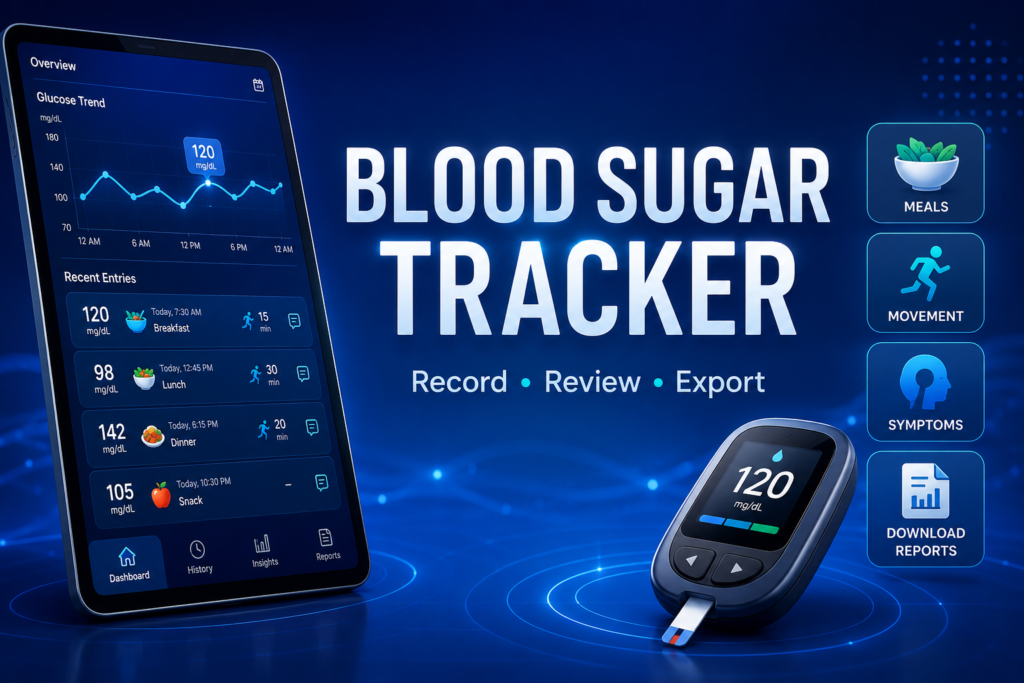
Record your blood glucose readings alongside meals, medicines, activity, symptoms and other useful notes. Review your entries over time and prepare a clearer record to discuss with your healthcare team.
- Use mmol/L or mg/dL
- Review averages and patterns
- Print or export your entries
Record and review
Track Your Blood Sugar Readings
Add each reading with useful context such as meals, medicines, activity, sleep and symptoms. Your healthcare professional can help you decide when to check and which target range is appropriate for you.
Add a Reading
Required fields are marked with an asterisk. Optional details can make your record more useful when reviewing possible patterns.
Display and target settings
Your Saved Readings
The summary below uses the entries currently included by your filters.
| Date and time | Reading | Context | Meal and activity | Symptoms and notes | Actions |
|---|---|---|---|---|---|
| No readings have been saved yet. | |||||
Showing 0 entries
Step-by-step instructions
How to Use the Blood Sugar Tracker
Recording readings consistently and adding relevant context can help make your log easier to review with your healthcare professional.
-
Choose your preferred glucose unit
Select mmol/L or mg/dL. Australian glucose meters generally display mmol/L, while mg/dL is commonly used in the United States. Changing the display unit automatically converts your saved readings.
-
Enter your personal target range if you have one
Only enter a range recommended by your doctor, diabetes educator or other qualified healthcare professional. Leave these fields blank if you have not been given an individual target.
-
Add the date, time, reading and context
Record whether the reading was fasting, before or after a meal, around physical activity, before bed, during the night or taken when you were feeling unwell.
-
Add any useful supporting details
You can record meals, estimated carbohydrate intake, usual medicines, activity, sleep, stress, illness and symptoms. You do not have to complete every optional field for every entry.
-
Save and review your entries
Use the filters to review the last 7 days, last 30 days, all entries or a particular testing context. You can edit mistakes, print a summary or download an Excel-compatible CSV file.
What Information May Be Useful to Record?
Timing and context
Record the date, time and whether the reading was fasting, before a meal, after a meal, around activity or taken because of symptoms.
Meals and carbohydrates
Note the meal or drink, estimated carbohydrate amount and how much time had passed between eating and checking your blood sugar.
Medicines and insulin
Record what you normally took and when. This tracker must not be used to calculate a dose or make medication changes.
Physical activity
Include the type, approximate duration and timing of recent activity, especially when comparing readings taken before and afterwards.
Sleep, stress and illness
These details provide additional context when a reading differs from what you usually expect or when reviewing several days together.
Symptoms and unusual events
Record symptoms, missed meals, disrupted routines or other unusual circumstances, and follow your personal management plan when needed.
Review your record
Understanding Your Tracker Summary
The summary describes the readings included by your selected filters. It can help organise your observations, but it cannot determine why a reading changed or whether your treatment should be adjusted.
What the Summary Figures Mean
Changing the time-period or context filter automatically recalculates these figures.
| Summary | What it shows |
|---|---|
| Entries | The number of saved readings included by the current filters. |
| Average | The mathematical average of the included readings. It may conceal individual highs and lows, so review the entries too. |
| Lowest | The lowest recorded value within the filtered period—not necessarily your usual level. |
| Highest | The highest recorded value within the filtered period. Check its timing, context and accompanying notes. |
| Within your target | The percentage of included readings inside the personal range you entered. It remains unavailable until both limits are set. |
Questions to Ask When Reviewing Entries
Look for repeated observations rather than drawing a conclusion from one isolated result.
- Does something recur at a similar time? Compare fasting, before-meal, after-meal, bedtime and overnight entries across several days.
- Were similar meals followed by similar readings? Review the foods, carbohydrate estimate and time between eating and checking.
- Was physical activity recorded nearby? Compare the activity type, duration and whether the reading was taken before or afterwards.
- Were sleep, stress or illness different? These notes provide context when a result differs from what you normally observe.
- Were symptoms recorded with the reading? Note repeated symptoms and discuss them with your healthcare professional, particularly if they are new or worsening.
- Is there enough information to compare? Two readings taken under very different circumstances may not provide a useful like-for-like comparison.
Medical safety
When to Seek Medical Help
A saved reading should never delay urgent care. Follow your personal hypo, hyperglycaemia, ketone and sick-day instructions whenever they apply.
Call Emergency Services Immediately
Seek emergency help if the person has diabetes or a suspected blood-sugar emergency and experiences:
- Unconsciousness or greatly reduced consciousness
- A seizure or convulsion
- Severe confusion, unusual behaviour or slurred speech
- Drowsiness or an inability to swallow safely
- Fast or difficult breathing
- Repeated vomiting or severe abdominal pain
- Breath that smells fruity or similar to acetone
- Symptoms of diabetic ketoacidosis or rapid deterioration
If someone is unconscious or too drowsy to swallow: do not give them food or drink. Place them in the recovery position if you can do so safely and call an ambulance. Use prescribed glucagon only if it is available and you have been shown how to use it.
Seek Prompt Medical Advice
- Readings remain outside the range or action limits given to you by your healthcare professional.
- A low blood sugar reading does not improve after following your personal hypo treatment plan.
- You have repeated low readings, nighttime lows or reduced awareness of hypo symptoms.
- You are unwell, dehydrated, vomiting or unable to keep fluids down.
- Ketones are present or elevated according to your prescribed ketone-management instructions.
- You use insulin or an SGLT2 inhibitor and develop possible DKA symptoms—even if the glucose reading is not extremely high.
Arrange a Routine Review
- You notice repeated changes at the same time of day.
- Readings frequently differ from the personal targets given to you.
- Meals, activity or illness appear repeatedly alongside unexpected readings.
- You are uncertain how often or when you should be checking.
- You need an individual blood sugar target or a written sick-day plan.
- You have questions about your meter, test strips, medicines or insulin routine.
Use your record effectively
Preparing for a Healthcare Appointment
A concise log with clear context may be easier to discuss than a long list of unexplained numbers. Review your entries beforehand and identify the questions you want answered.
Select the most relevant period
Use the 7-day, 30-day or context filters to focus on the entries your healthcare professional asked you to collect.
Review and correct your entries
Check dates, times, units and notes. Add important context you remember and correct accidental entries before preparing the summary.
Print or download the record
Print the filtered summary or download the CSV file for Excel. Keep the file secure because it may contain personal health information.
Useful Information to Bring
- Your printed or downloaded blood sugar record
- Your glucose meter or relevant device report, if requested
- A current list of medicines, insulin and supplements
- Notes about repeated symptoms or unusual readings
- Relevant meal, activity, sleep, stress or illness details
- Your existing target range and sick-day instructions
- A written list of questions you want to discuss
Questions You May Want to Ask
- When and how often should I check my blood sugar?
- What personal target range should I use in this tracker?
- Which repeated observations in my log are most relevant?
- What should I do when a reading is outside my action limits?
- Do I need a written hypo, ketone or sick-day plan?
- When should I seek same-day or emergency medical help?
Do not delay urgent medical care while preparing or printing a tracker summary.
Common questions
Frequently Asked Questions About the Blood Sugar Tracker
Learn how the tracker stores, displays, exports and manages your saved blood sugar entries.
What is the Blood Sugar Tracker?
The Blood Sugar Tracker is a free browser-based tool for recording glucose readings with information such as the date, time, meal context, medicines, activity, sleep, stress, illness and symptoms. It also provides a simple summary of the entries selected by your filters.
Where are my blood sugar entries stored?
Your entries are stored locally in the browser on the device you are using. They are not submitted to or stored by Blood Sugar Insider. Other people who can access the same browser may be able to view them.
Will my entries appear on another device?
No. The tracker does not automatically sync entries between phones, tablets, computers or different browsers. You can download a CSV copy if you need to move or retain your information elsewhere.
Can I use mmol/L and mg/dL?
Yes. You can switch the display between mmol/L and mg/dL. The tracker converts the saved readings and summary figures automatically without creating duplicate entries.
How often should I record my blood sugar?
The appropriate testing schedule depends on your health, diabetes treatment, medicines and personal management plan. Ask your doctor or diabetes educator when and how often you should check. This tool does not establish a testing schedule.
What target range should I enter?
Enter only the personal target range provided by your doctor, diabetes educator or another qualified healthcare professional. Leave the target fields blank if you have not been given an individual range.
Can I edit or delete a saved reading?
Yes. Select Edit beside an entry to change its details, or select Delete to remove that individual entry. The Clear All Entries button permanently removes every saved entry after confirmation.
Can I download the readings into Excel?
Yes. The Download for Excel button creates a CSV file containing the entries included by your current filters. CSV files can usually be opened by Microsoft Excel, Google Sheets and similar spreadsheet programs.
Will clearing my browser data delete the tracker entries?
It may. Clearing website data, resetting the browser, using private browsing or removing the browser can erase locally stored entries. Download a CSV copy regularly if the information is important to you.
Can this tracker diagnose diabetes or recommend treatment?
No. The tracker organises information only. It cannot diagnose diabetes, explain why a reading changed, determine your personal target or recommend changes to food, activity, medicines or insulin. Discuss unexpected or repeated results with a qualified healthcare professional.
Keep Your Blood Sugar Record Clear and Organised
Add your next reading, include the context that matters and build a record you can print or download before speaking with your healthcare professional.
Your saved tracker entries remain in this browser unless you delete them or clear the browser’s stored website data.
Evidence and safety sources
Trusted References
The educational and safety information accompanying this tracker was informed by government health services and recognised diabetes organisations. External links open in a new tab.
-
National Diabetes Services Scheme
Finger Prick Blood Glucose Checks
Guidance on finger-prick monitoring, personal testing schedules, target ranges and factors that can affect readings.
-
Diabetes Australia
Blood Glucose Monitoring
Information about checking and recording blood glucose readings and reviewing them with a diabetes healthcare team.
-
National Institute of Diabetes and Digestive and Kidney Diseases
Managing Diabetes
Guidance on keeping a record of glucose checks with details such as date, time, food and physical activity.
-
Centers for Disease Control and Prevention
Monitoring Your Blood Sugar
General information about blood glucose meters, checking a reading and maintaining a written or electronic record.
-
Healthdirect Australia
Hypoglycaemia (Low Blood Sugar)
Australian guidance covering hypo symptoms, treatment principles and when severe hypoglycaemia requires emergency care.
-
Healthdirect Australia
Diabetic Ketoacidosis
Information about DKA warning signs, sick-day planning and the need for immediate emergency assessment when symptoms occur.
Sources checked 27 August 2026. External organisations may update their guidance over time.
Written by Blood Sugar Insider Editorial Team
Health researchers and writers specializing in blood sugar control, metabolic health, and evidence-based nutrition.
Our editorial team creates evidence-based content designed to help readers understand blood sugar balance, prevent spikes, and support long-term metabolic health using science-backed strategies.
Medically Reviewed for Accuracy
This content has been reviewed for accuracy and clarity by the Blood Sugar Insider Medical Review Team, using current clinical research and evidence-based guidelines.
Our process ensures that information related to blood sugar, metabolism, and health strategies aligns with current scientific understanding and evidence-based practices.
View our Editorial Policy →
Affiliate Transparency
Blood Sugar Insider may earn a commission when you click certain links or purchase through recommended resources. This comes at no extra cost to you.
Affiliate relationships do not control our editorial guidance. We aim to keep our content helpful, balanced, and focused on reader education.
Important Safety Note
This content is for educational purposes only and should not replace medical advice, diagnosis, or treatment from a qualified healthcare professional.
Always speak with your doctor before changing your diet, supplements, medication, or blood sugar management routine, especially if you have diabetes, prediabetes, or take glucose-lowering medication.