
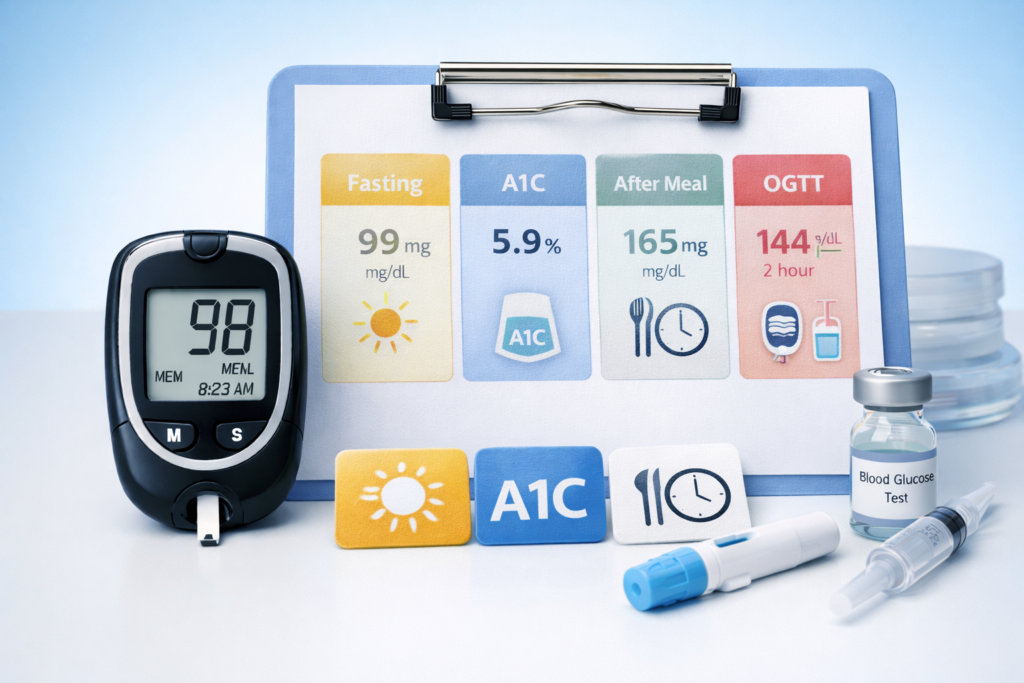
If you are trying to understand what blood sugar numbers mean, the first step is knowing that one number alone is rarely enough. A fasting result, an A1C percentage, a post-meal reading, and a glucose tolerance result do not mean the same thing, which is why this page belongs inside the wider Blood Sugar Basics section rather than as a standalone interpretation chart.
Most confusion happens when people look at a number without knowing what type of test produced it or what context surrounds it. A reading that looks high in one setting may be interpreted very differently in another, which is why pages like Fasting Blood Sugar Explained and A1C Explained are important companion reads when trying to make sense of your results clearly.
The First Rule: Ask “What Kind of Number Is This?”
Before interpreting any blood sugar result, ask:
- Is this fasting glucose?
- Is this A1C?
- Is this 1 to 2 hours after a meal?
- Is this from a 2-hour oral glucose tolerance test?
- Is this part of a CGM pattern?
- Is this a diagnostic lab result or a daily self-monitoring target?
That single question prevents most interpretation mistakes.
What Fasting Blood Sugar Numbers Mean
A fasting blood sugar test is done after at least 8 hours without food, usually first thing in the morning. NIDDK and CDC use these diagnostic ranges for most nonpregnant adults:
- 99 mg/dL or below = normal
- 100 to 125 mg/dL = prediabetes
- 126 mg/dL or above = diabetes range
So if your fasting glucose is:
- 92 → usually normal
- 108 → usually prediabetes range
- 128 → diabetes-range result that needs proper clinical confirmation and interpretation
If you want the full breakdown, see Fasting Blood Sugar Explained.
What A1C Numbers Mean
A1C is different because it reflects your average blood sugar over about the past 3 months rather than one moment in time. CDC and NIDDK define the diagnostic ranges as:
- Below 5.7% = normal
- 5.7% to 6.4% = prediabetes
- 6.5% or above = diabetes range
So if your A1C is:
- 5.4% → usually normal
- 5.9% → prediabetes range
- 6.7% → diabetes range
A1C is useful because it shows the longer pattern, but NIDDK also notes that A1C can miss prediabetes in some people and may not always match blood glucose tests exactly.
If you want more detail, see A1C Explained.
What 2-Hour Glucose Tolerance Numbers Mean
The oral glucose tolerance test is a formal lab test, not the same thing as just checking your sugar two hours after lunch. CDC uses these 2-hour diagnostic ranges after the glucose drink:
- 140 mg/dL or below = normal
- 140 to 199 mg/dL = prediabetes
- 200 mg/dL or above = diabetes range
This test can catch blood sugar problems that fasting or A1C may miss, which is why NIDDK notes it is more sensitive than some other methods, even though it is less convenient.
What Post-Meal Blood Sugar Numbers Mean
Post-meal, or postprandial, blood sugar is interpreted differently from diagnostic testing. ADA says that for most nonpregnant adults with diabetes, a common target is:
- Less than 180 mg/dL at 1 to 2 hours after the start of a meal
That is a management target, not a diagnostic rule for the general population. This is one of the biggest places readers get tripped up.
So:
- a post-meal 165 mg/dL may still be within a common diabetes management target
- but a fasting 165 mg/dL would be far above normal and clearly concerning
For the full explanation, see Post-Meal Blood Sugar Explained.
What CGM Numbers Mean
CGM adds another layer. ADA says time in range refers to the amount of time glucose stays within the target range, which is 70 to 180 mg/dL for most people. That means CGM interpretation is often about patterns, not one isolated number.
This matters because someone can have:
- an acceptable A1C
- a decent fasting number
- but still spend too much time spiking high after meals or dipping low later
If you want that broader pattern-based view, see CGM Guide for Non Diabetics.
Why the Same Number Can Mean Different Things
Here is the simplest way to think about it:
- 100 fasting = prediabetes threshold
- 100 A1C = not a valid A1C format at all
- 100 mg/dL after a meal = often unremarkable depending on context
- 100 mg/dL on a CGM = just one point in a trend, not the whole story
So blood sugar numbers only become meaningful when you know:
- what test type it is
- when it was measured
- whether it is for diagnosis or management
- what pattern surrounds it
Quick Blood Sugar Interpretation Chart
Number Type: Fasting glucose
- Normal / Common Target: 99 mg/dL or below
- Borderline / Prediabetes: 100–125 mg/dL
- Diabetes Range / High: 126 mg/dL or above
Number Type: A1C
- Normal / Common Target: Below 5.7%
- Borderline / Prediabetes: 5.7%–6.4%
- Diabetes Range / High: 6.5% or above
Number Type: 2-hour OGTT
- Normal / Common Target: 140 mg/dL or below
- Borderline / Prediabetes: 140–199 mg/dL
- Diabetes Range / High: 200 mg/dL or above
Number Type: Post-meal target for many adults with diabetes
- Normal / Common Target: Less than 180 mg/dL at 1–2 hours
- Borderline / Prediabetes: —
- Diabetes Range / High: Above individualized goal
The first three rows are diagnostic ranges; the last row is a management target for many adults with diabetes.
What Blood Sugar Numbers Do Not Tell You by Themselves
A number alone does not tell you:
- whether the reading was repeated
- whether you were sick or stressed
- whether you slept badly
- whether your glucose spikes after certain foods
- whether insulin resistance is building in the background
- whether your A1C and fasting results match each other
That is why this page should steer readers toward pattern-based interpretation, not fear-based interpretation.
When a Number Becomes More Concerning
You should take the result more seriously when:
- fasting glucose is repeatedly 100 mg/dL or higher
- A1C is 5.7% or higher
- the 2-hour OGTT is 140 mg/dL or higher
- post-meal readings are repeatedly above target
- symptoms like thirst, fatigue, blurry vision, frequent urination, or shakiness are present
This is also where What Is Insulin Resistance becomes an important next page, because rising numbers often reflect a deeper loss of insulin sensitivity. NIDDK directly links prediabetes and insulin resistance in its patient guidance.
The Best Way to Read Blood Sugar Results Clearly
A practical order is:
- identify the test type
- compare it to the correct reference range
- ask whether it is diagnostic or a management target
- look at the pattern, not just one reading
- combine the number with symptoms, context, and other tests
That is the clearest framework for understanding what blood sugar numbers mean.
Conclusion
If you were searching for what blood sugar numbers mean, the main takeaway is this: numbers only make sense when you know what kind of test produced them. Fasting glucose, A1C, glucose tolerance testing, post-meal readings, and CGM patterns all answer different questions. The best interpretation comes from using the right reference range, looking at patterns over time, and understanding the bigger metabolic context behind the result.
Related Articles
FAQ
What do blood sugar numbers mean?
Blood sugar numbers mean different things depending on the test type. Fasting glucose, A1C, post-meal glucose, glucose tolerance testing, and CGM readings all use different interpretation rules.
What is a normal fasting blood sugar?
For most nonpregnant adults, normal fasting blood sugar is 99 mg/dL or below.
What A1C is considered normal?
A normal A1C is below 5.7% for most nonpregnant adults.
What blood sugar level means prediabetes?
Prediabetes is generally defined as fasting glucose 100 to 125 mg/dL, A1C 5.7% to 6.4%, or 2-hour OGTT 140 to 199 mg/dL.
What blood sugar level means diabetes?
Diabetes is generally diagnosed at fasting glucose 126 mg/dL or above, A1C 6.5% or above, or 2-hour OGTT 200 mg/dL or above.
Is 130 mg/dL always bad?
No. A fasting 130 mg/dL is concerning, but ADA also says many adults with diabetes use a pre-meal target range of 80 to 130 mg/dL. Context matters.
What is a good blood sugar after eating?
For most nonpregnant adults with diabetes, a common target is less than 180 mg/dL at 1 to 2 hours after the start of a meal.
What is time in range?
Time in range is the amount of time glucose stays within the target range, which ADA defines as 70 to 180 mg/dL for most people.
Make Sense of Your Blood Sugar Results
A number only means something when you know what kind of test produced it. Use the Basics section, then go deeper into fasting glucose, A1C, post-meal readings, and your full management plan.
Written by Blood Sugar Insider Editorial Team
Health researchers and writers specializing in blood sugar control, metabolic health, and evidence-based nutrition.
Our editorial team creates evidence-based content designed to help readers understand blood sugar balance, prevent spikes, and support long-term metabolic health using science-backed strategies.
Medically Reviewed for Accuracy
This content has been reviewed for accuracy and clarity by the Blood Sugar Insider Medical Review Team, using current clinical research and evidence-based guidelines.
Our process ensures that information related to blood sugar, metabolism, and health strategies aligns with current scientific understanding and evidence-based practices.
View our Editorial Policy →