
If you need fasting blood sugar explained clearly, start with this: fasting blood sugar is your glucose level after not eating overnight, usually measured first thing in the morning. It is one of the most common blood sugar tests and an important part of the wider Blood Sugar Basics framework because it helps show how your body is managing glucose at baseline, before food changes the picture.
At the same time, fasting glucose is only one piece of the story. A morning result can look acceptable while other markers still suggest trouble, which is why it should be understood alongside pages like A1C Explained and What Blood Sugar Numbers Mean rather than interpreted in isolation.
What Is Fasting Blood Sugar?
Fasting blood sugar, also called fasting plasma glucose or FPG, is a blood test that checks your glucose level after a period without food. For the most reliable result, NIDDK says the test is usually given in the morning after at least 8 hours of fasting, with only sips of water allowed.
This matters because eating changes blood glucose. The fasting test tries to remove the immediate effect of food so your baseline regulation can be measured more cleanly. In practice, that makes fasting blood sugar useful for spotting impaired fasting glucose, prediabetes, and diabetes.
What Is a Normal Fasting Blood Sugar?
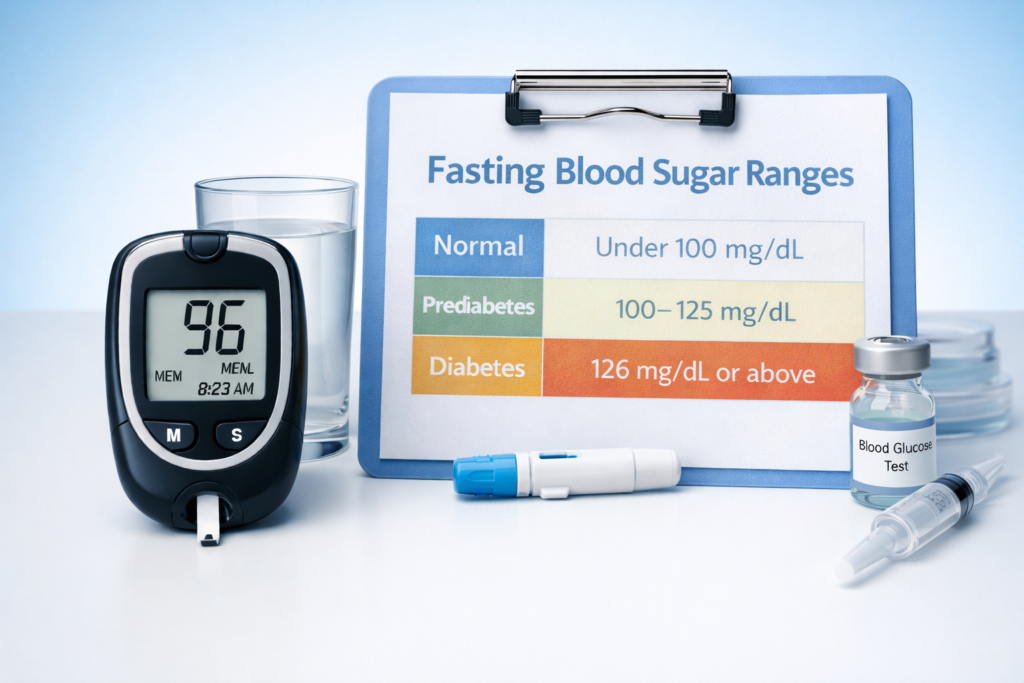
Here are the standard fasting ranges for diagnosing prediabetes and diabetes in people who are not pregnant:
Normal: 99 mg/dL or below
Prediabetes: 100 to 125 mg/dL
Diabetes: 126 mg/dL or above
That means a fasting reading of 92 is generally considered normal, a fasting reading of 108 is in the prediabetes range, and a fasting reading of 128 is in the diabetes range pending proper clinical confirmation. NIDDK notes that if you are pregnant, some tests use different cutoffs, so pregnancy should be treated separately from standard adult interpretation.
Fasting Blood Sugar Range Chart
Fasting Blood Sugar | What It Usually Means
- Under 100 mg/dL: Normal
- 100–125 mg/dL: Prediabetes / impaired fasting glucose
- 126 mg/dL or above: Diabetes range
These are CDC/NIDDK diagnostic thresholds for standard lab interpretation in nonpregnant adults.
Why Fasting Blood Sugar Matters
Fasting glucose is one of the clearest entry-level tests because it is widely available, inexpensive, and commonly used for screening. NIDDK’s clinician guidance lists it as a standard test for screening and diagnosis of both prediabetes and diabetes.
It can also reveal problems before a person receives a formal diagnosis. NIDDK states that prediabetes includes fasting plasma glucose from 100 to 125 mg/dL, and that people with prediabetes have a high chance of developing type 2 diabetes within 5 to 10 years if nothing changes.
That makes fasting glucose a strong early warning sign, especially when it shows up alongside belly fat, fatigue, poor sleep, cravings, or signs of insulin resistance. Insulin resistance is one of the central mechanisms behind prediabetes and type 2 diabetes.
What Fasting Blood Sugar Does Not Tell You
A fasting result is helpful, but it does not tell you everything.
It does not show how high your blood sugar rises after meals. It also does not replace A1C, which reflects average glucose over about 3 months, or an oral glucose tolerance test, which can detect glucose problems that fasting testing may miss. NIDDK’s clinician guidance describes fasting plasma glucose as more sensitive than A1C but less sensitive than the oral glucose tolerance test.
That means someone can have a fasting number that looks acceptable while still having post-meal spikes, rising A1C, or underlying insulin resistance. If you want the bigger picture, pair this article with:
When a Fasting Result Can Be Misleading
NIDDK notes that fasting plasma glucose is affected by short-term lifestyle changes, stress, or illness, and that it has meaningful biological variability. Their clinician guidance even illustrates that a reported fasting value of 126 mg/dL could reflect a true value across a wider range due to normal variability.
That is why one isolated result should not always be overinterpreted. A borderline fasting number may need repeat testing, comparison with A1C, and clinical context.
It is also important to know that diagnosis requires a laboratory test. NIDDK’s clinician guidance explicitly states that meter results are not suitable for diagnosis. Home glucose readings can still be useful for spotting patterns, but they are not the standard way to diagnose diabetes or prediabetes.
Why Morning Fasting Blood Sugar Can Be High
A fasting number can rise for more than one reason. In addition to insulin resistance and overall glucose dysregulation, morning highs can be influenced by poor sleep, stress, illness, and in people with diabetes, the dawn phenomenon, an early-morning rise in blood glucose. CDC also notes that losing sleep can make the body use insulin less well, and ADA explains that the dawn phenomenon can contribute to higher morning glucose.
So if your fasting glucose is creeping up, it may reflect more than just what you ate the night before.
What Is Considered Too Low?
Low blood sugar is generally considered below 70 mg/dL. CDC says blood sugar below 70 mg/dL is low and should be treated, especially in people using diabetes medications that can cause hypoglycemia. Common symptoms include shaking, sweating, dizziness, hunger, anxiety, and fast heartbeat.
If you are not on glucose-lowering medication and keep getting low fasting readings or symptoms, that should be discussed with a healthcare professional rather than assumed to be harmless.
Fasting Blood Sugar vs. A1C
These tests answer different questions.
Fasting blood sugar shows your glucose at one moment after fasting.
A1C estimates your average glucose over about the last 3 months.
That is why someone can have:
- a borderline fasting result with a still-normal A1C
- a normal fasting result with a higher A1C
- or mismatched results that need further evaluation
NIDDK also notes that A1C may miss prediabetes in some people with certain health conditions, which is another reason fasting glucose and A1C are often interpreted together rather than in isolation.
Fasting Blood Sugar vs. Daily Diabetes Targets
People often mix up diagnostic fasting ranges with management targets.
For diagnosis in nonpregnant adults, fasting under 100 mg/dL is normal. But for most nonpregnant adults already living with diabetes, ADA suggests common glucose targets of 80 to 130 mg/dL before meals and under 180 mg/dL 1 to 2 hours after the start of a meal, with A1C goals individualized by age and health. Those are management targets, not the same thing as normal lab screening values.
What To Do If Your Fasting Blood Sugar Is High
If your fasting glucose is mildly elevated, the goal is to look at the pattern, not panic over one number.
NIDDK says healthy living may help prevent or reverse insulin resistance and prediabetes, including healthy food and drink choices, physical activity, weight management, and enough sleep. NIH-funded Diabetes Prevention Program research also found that losing 5% to 7% of starting body weight helped reduce the chance of developing type 2 diabetes in high-risk adults.
That makes these next steps logical:
- improve sleep quality
- walk after meals
- build meals around protein, fiber, and less refined carbohydrate
- reduce excess abdominal fat if needed
- improve insulin sensitivity through regular movement
- look beyond fasting alone and understand your full glucose pattern
Good next pages:
- Blood Sugar Basics
- What Blood Sugar Numbers Mean
- How to Improve Insulin Sensitivity Naturally
- Blood Sugar Management Guide
When To Speak With a Doctor
You should take a fasting blood sugar result seriously when:
- it repeatedly comes back at 100 mg/dL or higher
- it reaches 126 mg/dL or above
- it is paired with symptoms such as thirst, frequent urination, fatigue, blurred vision, or unexplained weight loss
- you are pregnant
- your fasting number does not match how you feel or seems inconsistent with other tests
Because fasting glucose is only one piece of the picture, the best interpretation often comes from combining it with symptoms, A1C, and broader metabolic context.
Conclusion
If you were searching for fasting blood sugar explained, the simplest summary is this: it is a morning lab test taken after at least 8 hours of fasting, it helps screen for prediabetes and diabetes, and the key thresholds are under 100 mg/dL for normal, 100 to 125 mg/dL for prediabetes, and 126 mg/dL or above for diabetes range. But fasting glucose is still only one data point, and it works best when interpreted alongside A1C, symptoms, and the bigger picture of insulin resistance and daily glucose patterns.
Related Articles
FAQ
What is a normal fasting blood sugar?
For most nonpregnant adults, normal fasting blood sugar is 99 mg/dL or below. Prediabetes is 100 to 125 mg/dL, and diabetes is 126 mg/dL or above.
How long do you need to fast before a fasting blood sugar test?
NIDDK says you should fast for at least 8 hours, usually overnight, and only have sips of water before the test.
Is 110 fasting blood sugar normal?
No. A fasting blood sugar of 110 mg/dL falls in the prediabetes range.
Is fasting blood sugar the same as A1C?
No. Fasting blood sugar is a one-time measurement after fasting, while A1C reflects average glucose over about the past 3 months.
Can fasting blood sugar be high even if A1C is normal?
Yes. Because fasting blood sugar and A1C measure different things, they can sometimes disagree, and additional testing may be needed. NIDDK also notes that A1C can miss prediabetes in some people with certain health conditions.
Can stress or illness raise fasting blood sugar?
Yes. NIDDK’s clinician guidance says fasting plasma glucose can be affected by short-term lifestyle changes such as stress or illness.
Does a home glucose meter diagnose diabetes?
No. NIDDK’s clinician guidance says diagnosis requires a lab test and that meter results are not suitable for diagnosis.
What blood sugar level is considered low?
CDC says below 70 mg/dL is considered low blood sugar.
Why can fasting blood sugar be high in the morning?
Morning highs can reflect overall glucose dysregulation, stress, poor sleep, illness, insulin resistance, or in people with diabetes, the dawn phenomenon.
What should I do if my fasting blood sugar is high?
If it keeps coming back at 100 mg/dL or higher, it is worth following up with a healthcare professional and considering repeat testing, A1C, and lifestyle changes that improve insulin sensitivity.
See What Your Fasting Number Really Means
A single fasting result is useful, but it makes more sense when you compare it with A1C, symptoms, and the bigger blood sugar picture.
Written by Blood Sugar Insider Editorial Team
Health researchers and writers specializing in blood sugar control, metabolic health, and evidence-based nutrition.
Our editorial team creates evidence-based content designed to help readers understand blood sugar balance, prevent spikes, and support long-term metabolic health using science-backed strategies.
Medically Reviewed for Accuracy
This content has been reviewed for accuracy and clarity by the Blood Sugar Insider Medical Review Team, using current clinical research and evidence-based guidelines.
Our process ensures that information related to blood sugar, metabolism, and health strategies aligns with current scientific understanding and evidence-based practices.
View our Editorial Policy →