
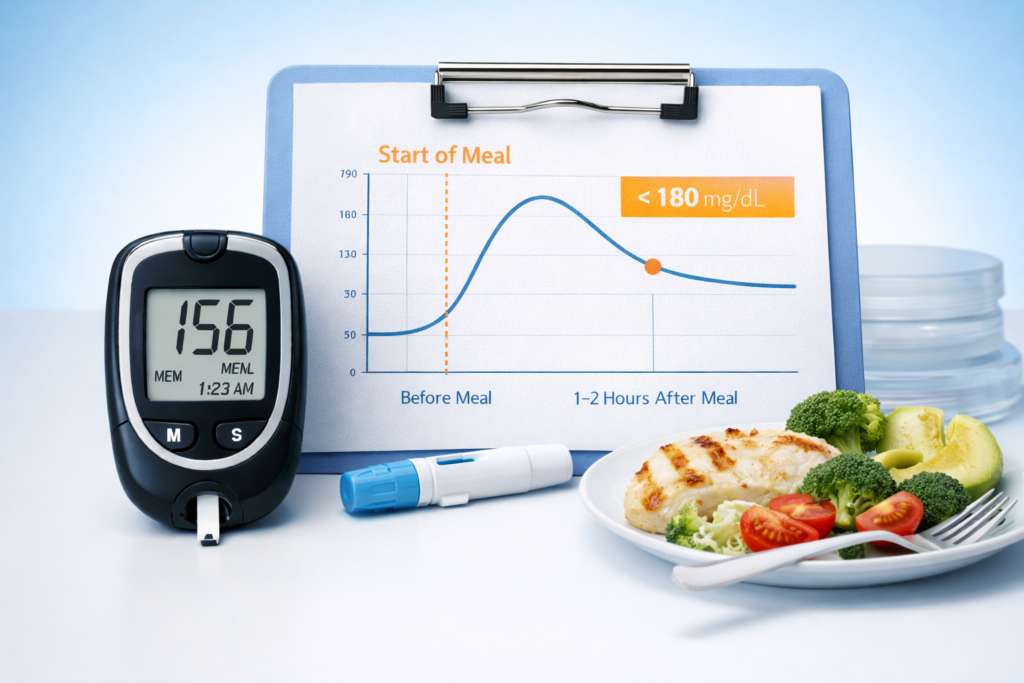
If you need post-meal blood sugar explained, the simplest place to begin is this: blood sugar usually rises after you eat, but how high it rises and how quickly it comes back down can tell you a lot about your glucose control. That is why this page sits inside the Blood Sugar Basics silo, where it helps connect everyday after-meal readings with the bigger picture of blood sugar regulation.
For many people, post-meal glucose is where the earliest problems begin to show up. Someone can have a fairly ordinary fasting result and still experience large rises after meals, especially when blood sugar spikes are frequent or when overall glucose control is becoming harder to manage. That is why after-meal readings should be understood in context, not dismissed as random fluctuations.
What Is Post-Meal Blood Sugar?
Post-meal blood sugar is your glucose level after eating. It reflects how your body handles the rise in glucose from a meal and how effectively insulin helps move that glucose out of the bloodstream and into cells. Food, activity, sleep, stress, and medications can all affect this number. ADA notes that food, physical activity, and medications all influence blood glucose levels.
For people using glucose monitoring, the most commonly referenced post-meal window is 1 to 2 hours after the beginning of the meal. That timing is used because postprandial glucose in diabetes typically peaks around then, and ADA’s guidance measures postprandial targets in that window.
What Is a Good Blood Sugar After Eating?
For most nonpregnant adults with diabetes, common target ranges are:
- Before meals: 80 to 130 mg/dL
- 1 to 2 hours after the start of a meal: below 180 mg/dL
That “below 180” number is a management target, not the same thing as the formal diagnostic cutoffs for prediabetes or diabetes. CDC also notes that blood sugar targets may differ depending on age, additional health problems, and the person’s care plan.
Post-Meal Blood Sugar vs. Glucose Tolerance Test
This is where many readers get confused.
A routine post-meal reading after breakfast, lunch, or dinner is not the same test as an oral glucose tolerance test. CDC’s diagnostic testing page explains that the glucose tolerance test is done after fasting, then drinking a glucose liquid, with blood sugar checked afterward. At 2 hours, the diagnostic ranges are:
- Normal: 140 mg/dL or below
- Prediabetes: 140 to 199 mg/dL
- Diabetes: 200 mg/dL or above
So there are really two different contexts:
- Everyday diabetes-management target after a meal: under 180 mg/dL
- Formal 2-hour glucose tolerance test for diagnosis: 140 and under is normal
That distinction should be made very clearly on the page.
When Does Blood Sugar Peak After Eating?
For diabetes-management guidance, ADA measures postprandial glucose 1 to 2 hours after the beginning of the meal, which is generally when the highest post-meal level occurs in people with diabetes.
In everyday life, the exact peak can vary depending on:
- the amount and type of carbohydrate in the meal
- how much protein, fat, and fiber were eaten
- whether the person moved after eating
- insulin sensitivity
- medications
- underlying glucose regulation
Why Post-Meal Blood Sugar Matters
A fasting glucose test is useful, but it can miss people whose biggest issue is what happens after meals. A1C also gives only an average over time. ADA explains that A1C or eAG reflects a 24-hour average and can include times when people are less likely to check, including post-meal periods of higher glucose.
That means someone can have:
- a near-normal fasting reading
- a reasonable A1C
- and still experience repeated large spikes after meals
This is one reason post-meal glucose can add valuable context, especially when symptoms, CGM data, or diet patterns suggest unstable blood sugar. NIDDK also emphasizes time-in-range concepts for many people with diabetes, commonly using a target range of 70 to 180 mg/dL.
What Can Make Post-Meal Blood Sugar Too High?
Post-meal glucose is often higher when meals contain a heavy load of refined or rapidly digested carbohydrate, when activity is low, or when insulin resistance is present. ADA and CDC both note that food choices, physical activity, and medications directly affect blood glucose.
Common contributors include:
- large refined-carb meals
- sugary drinks
- low protein and low fiber meals
- inactivity after eating
- poor sleep and stress
- insulin resistance
- insufficient medication in people with diabetes
Can Post-Meal Spikes Matter Even If Fasting Glucose Looks Fine?
Yes.
That is one of the most important reasons this page belongs in the Basics silo. Fasting glucose shows one moment after an overnight fast. A1C shows an average. Neither one shows exactly what happened after your last meal. ADA’s explanation of eAG also makes clear that averages can hide periods of higher glucose, including post-meal periods.
This is why readers should compare this page with:
What About Pregnancy?
Pregnancy uses different targets. NIDDK states that healthcare professionals often recommend:
- fasting, before meals, bedtime, and overnight: 70 to 95 mg/dL
- 1 hour after eating: 110 to 140 mg/dL
- 2 hours after eating: 100 to 120 mg/dL
So this page should make clear that its main discussion is about general blood sugar education and typical nonpregnant adult targets, not pregnancy-specific care.
What To Do If Your Post-Meal Blood Sugar Is High
If your after-meal blood sugar keeps running high, the smartest next step is to look at the pattern, not one isolated reading. CDC and NIDDK both emphasize healthy eating, physical activity, sleep, and staying in target range as core parts of glucose management.
Practical first steps include:
- reducing heavily refined carbohydrates
- increasing protein and fiber at meals
- walking after meals
- improving sleep quality
- checking whether the same foods repeatedly trigger larger spikes
- addressing insulin resistance and overall metabolic health
Good next pages:
- Blood Sugar Basics
- What Blood Sugar Numbers Mean
- Blood Sugar Spikes: Causes, Symptoms & How to Stop Them
- How to Improve Insulin Sensitivity Naturally
- Blood Sugar Management Guide
When To Speak With a Doctor
You should follow up with a healthcare professional if:
- your post-meal readings are repeatedly high
- your fasting and post-meal numbers do not match
- you have symptoms such as fatigue, thirst, frequent urination, blurry vision, or shakiness
- you are pregnant
- you are unsure whether you need diagnostic testing such as A1C, fasting glucose, or a glucose tolerance test
Conclusion
If you needed post-meal blood sugar explained, the clearest summary is this: blood sugar usually rises after eating, and for most nonpregnant adults with diabetes, a common target is below 180 mg/dL 1 to 2 hours after the start of a meal. But that is a diabetes-management target, not the same thing as the formal oral glucose tolerance test used for diagnosis. Post-meal glucose matters because it can reveal problems that fasting glucose or A1C alone may not fully show.
Related Articles
FAQ
What is post-meal blood sugar?
Post-meal blood sugar, or postprandial blood glucose, is your blood sugar level after eating. In diabetes care, it is commonly checked 1 to 2 hours after the beginning of a meal.
What is a good blood sugar after eating?
For most nonpregnant adults with diabetes, a common target is below 180 mg/dL 1 to 2 hours after the start of a meal.
Is post-meal blood sugar the same as a glucose tolerance test?
No. Everyday post-meal readings are not the same as a formal oral glucose tolerance test. The 2-hour glucose tolerance test uses a glucose drink and has separate diagnostic cutoffs.
What is normal 2 hours after a glucose tolerance test?
On the formal 2-hour glucose tolerance test, 140 mg/dL or below is normal, 140 to 199 mg/dL is prediabetes, and 200 mg/dL or above is diabetes range.
When does blood sugar usually peak after eating?
In diabetes-management guidance, postprandial glucose is commonly measured 1 to 2 hours after the beginning of the meal, which is generally when it peaks in people with diabetes.
Can post-meal spikes matter if fasting glucose is normal?
Yes. Fasting glucose and A1C do not always show what happens after meals, and averages can hide post-meal periods of higher glucose.
What can raise blood sugar after a meal?
Food composition, physical activity, medications, sleep, stress, and insulin resistance can all affect post-meal glucose.
Are pregnancy post-meal targets different?
Yes. NIDDK states that pregnancy often uses tighter targets, including 110 to 140 mg/dL 1 hour after eating and 100 to 120 mg/dL 2 hours after eating.
See What Happens to Your Blood Sugar After Meals
Post-meal glucose can reveal patterns that fasting tests and averages sometimes miss. Use the Basics section, then go deeper into spikes, insulin resistance, and the full management plan.

Written by Blood Sugar Insider Editorial Team
Health researchers and writers specializing in blood sugar control, metabolic health, and evidence-based nutrition.
Our editorial team creates evidence-based content designed to help readers understand blood sugar balance, prevent spikes, and support long-term metabolic health using science-backed strategies.
Medically Reviewed for Accuracy
This content has been reviewed for accuracy and clarity by the Blood Sugar Insider Medical Review Team, using current clinical research and evidence-based guidelines.
Our process ensures that information related to blood sugar, metabolism, and health strategies aligns with current scientific understanding and evidence-based practices.
View our Editorial Policy →